
Seaweed will save us
The oldest living organism on earth could solve our addiction to single-use plastic

Rodrigo Garcia Gonzalez grew up watching his grandparents live without plastic, because they were born before it existed. He is now building a business to make it disappear. Meanwhile, on the other side of the world, Kruti Bharucha is doing something similar in Indian classrooms: replacing what is broken with something more human.
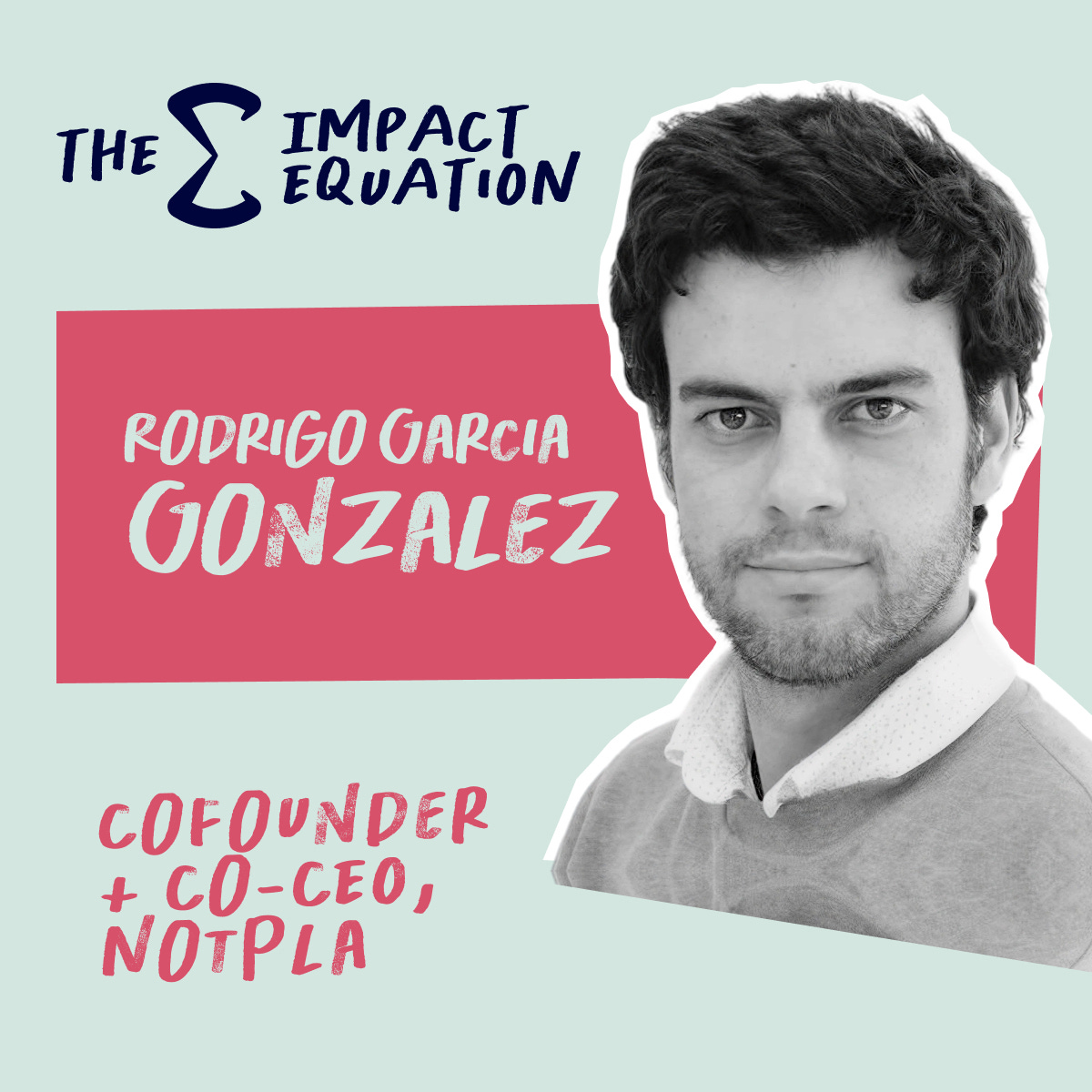
There is a certain poetry in the fact that the material helping to free humanity from its addiction to single-use plastic is also the oldest living organism on earth. Seaweed predates everything. It predates trees, insects, fish and the first hesitant creatures that crawled from the sea onto land. You could argue, as Rodrigo Garcia Gonzalez does with the quiet pleasure of someone who has thought about this at length, that we all come from seaweed. There is more genetic difference between a brown seaweed and a green seaweed, he tells us, than between his own DNA and a mushroom’s. It is an extraordinary thing to hold in the mind: that the answer to one of the most pressing material crises of our age has been sitting in the ocean, photosynthesising, for longer than anything else alive.
Rodrigo is the co-founder and co-CEO of Notpla, the London-based company on a mission to make plastic packaging disappear. What began as a speculative student experiment, an edible bubble of water sealed in a membrane made from seaweed extract, has grown into a serious manufacturing business operating across nine countries, supplying fifty stadiums in the UK, and counting Google, Apple, IKEA and Warner Brothers among its clients. It has won Prince William’s Earthshot Prize, the Grand Prix in design at Cannes Lions, the World Technology Award from Fortune and Time, and Wired Startup of the Year. By any measure, it is one of the most decorated young businesses in British sustainable enterprise.
But Rodrigo does not carry himself like a prize winner. He carries himself like a man who cannot stop generating ideas, who describes his own restlessness as both his greatest asset and, occasionally, his most honest weakness. “I’m relatively good at starting with new ideas,” he says, with a grin that suggests he has received this feedback before. “Which could also be a weakness, because sometimes I don’t close enough doors.”
Three grandparents, two toolboxes, one obsession
To understand Rodrigo, you have to go back to Spain, and to the grandparents he describes with warmth, all, in his words, deeply into sustainability without necessarily knowing what that word means.
His grandfather on one side was fascinated by electricity. His grandfather on the other was devoted to mechanics. They each gave him a physical toolbox: one filled with electrical tools, one with woodworking tools. Both men had grown up knowing the cost of materials, knowing that resources were finite, knowing how to reuse everything that passed through their hands. They had lived the bulk of their lives before plastic became ubiquitous, and so they simply never learned to depend on it. “They knew how to live without it,” Rodrigo says, “and how to almost reuse everything that came to their hands.”
His grandfather still drinks wine from two vessels: a bota de vino, a leather flask he has carried for decades, and a glass porron that sits on the table at every meal. Neither is plastic. Neither is wasteful. Both are objects of a kind of functional elegance that Rodrigo finds genuinely moving. The man is, as Rodrigo describes him, quite a lot of fun. He is also, without having set out to be, a living proof of concept.
The young Rodrigo channelled this inheritance into a cascade of inventions. Seeds pressed into cigarette butts so they would flower when thrown on the ground. A self-following suitcase that tracked your phone’s Bluetooth signal. A fifteen-storey deployable building that could be erected in three hours. A toothbrush you could use without leaving the bathroom, powered by saliva. A Brompton-beating foldable bike. He approached the world, and still does, as a series of design problems waiting to be reframed. Magic, he says, has always fascinated him. He has always tried to bring the magical aspect to daily life.
The move toward plastic came via a different route. He began working on an artificial cloud to deliver water, and found himself asking how to deliver water without using plastic. He began experimenting with natural materials, natural skins, natural membranes. He ended up with seaweed. Seaweed does not need to be chemically modified to contain water. It grows at up to a metre a day, making it the fastest organism on earth. It requires no farmland, no fresh water, no significant human intervention. It has been used in food, pharmaceuticals and textiles for decades. There are already forty million tonnes of it produced annually. And it biodegrades, completely, leaving nothing behind.
Plastic, by contrast, was invented fifty metres from where Rodrigo now sits in East London, by a man named Charles Parkes who intended it for coins and durable goods. Nobody intended it for packaging that would be discarded within hours and persist for seven hundred years. “If you package orange juice in plastic,” Rodrigo says, “the content lasts a week. The container lasts seven centuries.” It is a design mismatch of almost comic proportions, and it is the mismatch that Notpla exists to correct.
From bubbles to boxes
The first Notpla product was the edible bubble: a small sphere of seaweed membrane containing a single mouthful of water, no packaging required, no waste left behind. It was used at the London Marathon, where runners caught them and ate them whole. It proved the concept spectacularly. It also proved something more sobering: that making your own machinery and your own materials and your own business model from scratch is extraordinarily hard, and that Covid could end an events-based business overnight.
Just Eat Takeaway came to Notpla: the takeaway boxes they were using looked like cardboard on the outside but contained an internal layer of plastic that made them impossible to recycle. Could Notpla replace that layer with seaweed? They could. That product, a seaweed-coated cardboard box, is now Notpla’s highest-volume product, sold across nine countries, used in fifty UK stadiums, and increasingly adopted by quick service restaurants across Europe.
The business now operates across three distinct product lines: the coated cardboard boxes, edible and dissolvable films for sachets and wrapping, and pellets of seaweed that can be moulded or cast into cutlery, rigid containers or transparent packaging. An Australian company recently began buying Notpla pellets and turning them into chewable dog toys, ensuring that even dogs are now avoiding microplastics. Rodrigo finds this, understandably, quite satisfying.
The numbers are real but, as he is honest enough to say, still modest against the scale of the problem. Notpla has replaced thirty-five million units of plastic, and is replacing around forty thousand a day. Plastic production runs at four hundred million tonnes a year. The gap between where Notpla is and where it needs to be is enormous. What is closing it is not just product development but a shift in strategy: moving from selling finished boxes to selling the material itself, so that paper mills and manufacturers can coat their own products with seaweed at a scale that Notpla alone could never reach.
“The packaging industry is really traditional,” Rodrigo says, with equanimity. “It’s not easy to go to one of these big groups who are used to running a plant for thirty years without stopping and tell them they need to put seaweed in their line.” He is not discouraged by this. He has watched his prices fall thirty percent in a single year as volumes increase. He has seen the Netherlands government grant Notpla the first official recognition of a material that is legally not plastic under the EU single-use plastics directive. He has watched Prince William walk through stadiums and ask venue managers, personally, to switch their packaging. He has a patient, compounding theory of change, and he has the Earthshot prize money, the investor backing and the commercial clients to prosecute it.
A different kind of system change
Across our series of conversations on The Impact Equation, we have been struck by how often the most ambitious founders share a structural instinct: that the problem they are addressing cannot be solved by one organisation alone, and that the most important move is not to build bigger but to become an ingredient in something larger than yourself.
Rodrigo’s articulation of this is elegant. Notpla’s long-term ambition is not to be the company that makes every seaweed-based box in the world. It is to become what he calls an ingredient brand: to be to sustainable packaging what Intel is to computing, or what Gore-Tex is to outdoor clothing. A name that tells you something real about what is inside the product you are holding, a standard that travels further than any single company could carry it.
It is in this spirit that we turn to a conversation that sits alongside Rodrigo’s this week, and that we are proud to share as part of our partnership with 100x, the impact accelerator based at the London School of Economics.
Kruti Bharucha and the classroom that changes everything
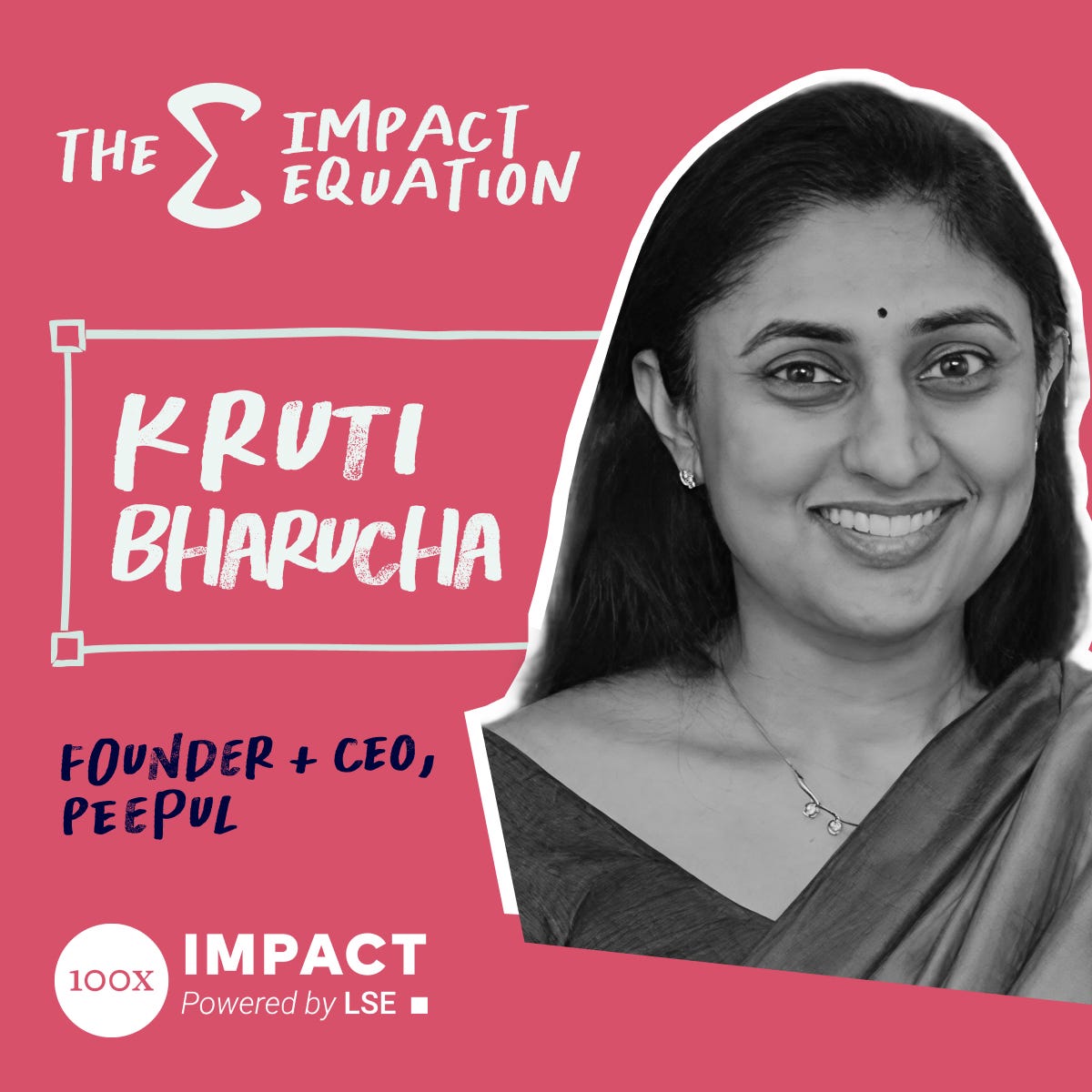
Kruti Bharucha could have stayed in the world she had built: McKinsey, the World Bank, the IMF, managing director of a corporate advisory firm by her mid-thirties. She chose not to. She became a mother. She watched her son navigate a school system that was not designed for children like him. And she thought about the hundreds of millions of children in India for whom the gap between the school they could access and the school they deserved was not a marginal difference but a chasm.
Peepul, the NGO she leads, now works shoulder to shoulder with state governments to improve the quality of education at scale across India. In Delhi, they run exemplar schools. In Madhya Pradesh, they support three hundred thousand teachers across one hundred thousand schools and deliver the Chief Minister’s flagship school reform programme. The scale is, by any reasonable measure, extraordinary for an organisation that began with one school and one woman asking whether she could make a difference to a certain number of children.
The problem she is working on is both vast and precise. India has 1.2 million government schools and 130 million children studying in them, drawn overwhelmingly from the country’s most vulnerable families. The outcomes those children are achieving are not acceptable: only around 65% of children finishing primary school can do basic mathematics at a grade two level. Only 55% can read at that level.
Peepul improves student engagement in the classroom as it is the key driver of learning outcomes. It does this through two pillars: academic strengthening, which means training teachers and school leaders and the mid-tier officials who coach them, and academic governance, which means working with state education departments on training calendars, rewards and recognition systems, and classroom observation protocols. It works at the classroom level. It also works at the policy level.
The story that stays with us is about a girl in the first year of the Delhi exemplar school who could not stay awake for more than thirty minutes. She was malnourished, begging on the streets, arriving at school without enough food to sustain attention. Peepul’s team diagnosed the problem, worked with her family, addressed her nutrition. A month later, Kruti walked into the classroom and found her sitting in a group, asking questions, wearing a smile that had not been there before. The child gave her a hug. That is the ledger entry that does not appear in any impact report, and that makes every other number make sense.
What Rodrigo and Kruti share
The connection between these two conversations is not obvious on the surface. One founder is turning seaweed into packaging in East London. The other is training teachers in Madhya Pradesh. But sit with both long enough and the same architecture emerges.
Both began not with a market analysis but with an observation: Rodrigo’s grandparents reusing everything, Kruti’s son needing a school that could see him. Both have had to resist the temptation to build everything themselves, learning instead to become the ingredient, the standard, the platform through which others can do the work at the scale that one organisation alone cannot reach. Rodrigo is moving from finished products to raw materials, so that paper mills can carry seaweed further than Notpla ever could. Kruti is moving from exemplar schools to policy influence, so that state governments can carry her model further than Peepul ever could. When the senior civil servant for education in Madhya Pradesh visited one of Peepul’s Delhi schools and said she wanted to replicate it across one hundred thousand schools, Kruti did not say the system was too large or too complex. She said yes, and figured out what that meant.
What Rodrigo’s grandparents understood, drinking wine from leather flasks and tinkering in their workshops, is what Kruti understood when she walked into that Delhi classroom and saw a girl who had not eaten enough to stay awake: that the solutions to the most serious problems we face are often not complicated. They are just ignored. Seaweed has been growing in the ocean for longer than anything else alive. Engaged, well-taught children have always learned better than neglected ones. The work is not to discover these things. The work is to build the systems that make them the default.
Our conversations with Rodrigo Garcia Gonzalez and Kruti Bharucha are both available now on The Impact Equation. The Kruti episode is produced in partnership with 100x, the impact accelerator at the London School of Economics.
Impact Equation on Spotify here and on Apple Podcasts here
Until next time,
Rafi and Adam